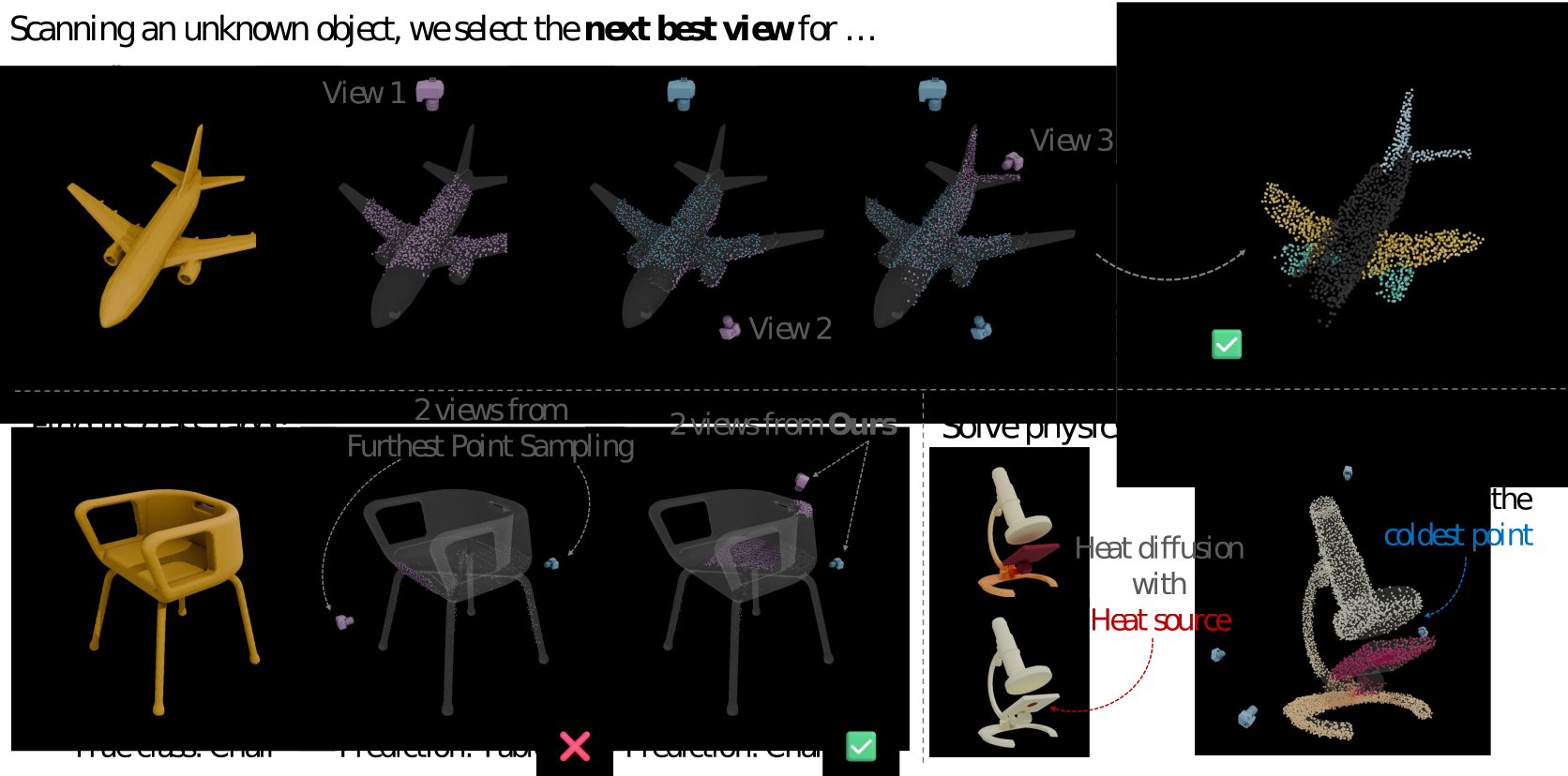
Abstract. We develop a framework for task-specific active next-best-view selection in 3D reconstruction from point clouds, by casting the problem in the language of Bayesian decision theory. Our framework works by (a) placing a prior distribution over the space of implicit surfaces, (b) using recently-developed stochastic surface reconstruction methods to calculate the resulting posterior distribution, then (c) using the posterior distribution to carefully reason about which view to scan next. This enables us to perform camera selection in a manner that is directly optimized for the intended use of the reconstructed data – meaning, we reduce uncertainty only in those regions that make a difference in the task at hand, as opposed to prior approaches that reduce it uniformly across space. We evaluate our method across three distinct downstream tasks: semantic classification, segmentation, and PDE-guided physics simulation. Experimental results demonstrate that our framework achieves superior task performance with fewer views compared to commonly used baselines and prior general uncertainty-reduction techniques.
Next-Best-View Selection
We begin by briefly describing the task we are trying to solve. Let be an implicit surface representation of the unknown scene. We assume that information about is acquired through a scanning operation , where represents camera angles, and is a space representing oriented point clouds. More precisely, consists of a dataset of surface locations , and surface normals , of matched but otherwise potentially variable length. We assume the unknown geometry is only accessible in a black-box manner through these discrete observations, to mimic 3D scanning applications without explicit prior knowledge assumed about the object. At each time step , we have a set of previously selected viewpoints , and the resulting cumulative dataset , where the union symbol denotes concatenation of observations. Our objective is to carefully select a subsequent viewpoint .
We formulate sequential scanning in a Bayesian manner, by placing a prior distribution over the implicit surface. We can condition this prior on the data to obtain the posterior distribution . Using this, we can compute simulated scans under the posterior distribution, denoted by .
Algorithm
With formalizing active point cloud scanning as a Bayesian decision problem, we design our algorithm as the following steps:
- Given the partially scanned point cloud at time step , we obtain the posterior geometry reconstruction through uncertain geometry reconstruction methods: specifically, we use Stochastic Poisson Surface Reconstruction throughout this work.1
- We define a utility function , which is task-dependent: describing how useful the information contained in a partial scan is for the task at hand.
- By conducting the simulated scan using the posterior, we select the next view according to the expected utility improvement acquisition function: this provides a score for the potential value of a candidate camera , and is defined as
- We then select the next view by solving the optimization problem
In practice, the expectation in is estimated by a Monte Carlo estimation from multiple samples from the posterior distribution . Please refer to Algorithm 1 in our paper for pseudocode.
Task-specific Utility Functions
Using the preceding ideas, we provide a general Bayesian next-best-view selection framework that allows for the tailoring of camera selection to the specific requirements of the downstream application, through the selection of utility and acquisition functions. Our paper handles the following as examples:
- 3D point cloud classification, to identify the correct class label of the underlying object with the minimum number of viewpoints.
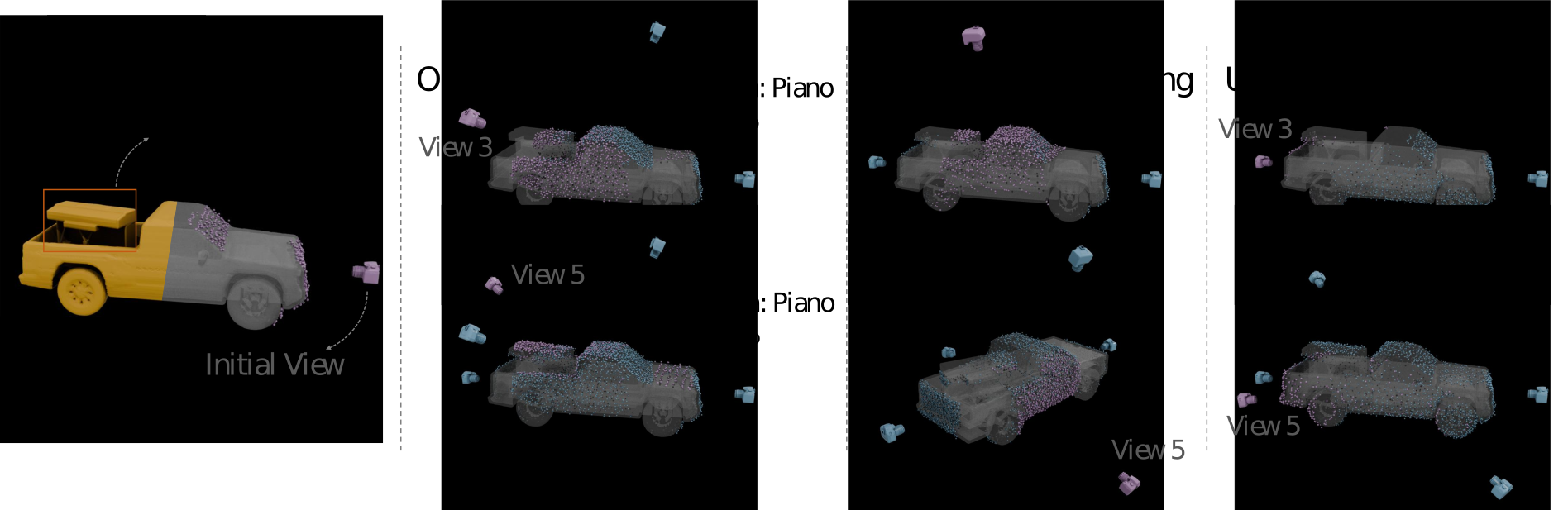
- 3D Semantic Segmentation and Part Discovery, to discover all semantic parts of the underlying object with minimal observations.
- Physics-Informed Scanning, driven by the physical properties of the reconstructed scene, for instance heat diffusion.
- Traditional task-agnostic 3D reconstruction, which typically aims for scene coverage and global scene uncertainty reduction.
Results
We evaluate the proposed method in several settings, shown in brief below.
Classification
Segmentation
Heat Diffusion
Citation
@article{zhu2026bayesian,
  title={A Bayesian Approach for Task-Specific Next-Best-View Selection with Uncertain Geometry},
  author={Zhu, Jingsen and Sellán, Silvia and Terenin, Alexander},
  journal={arXiv preprint arXiv:2605.05095},
  year={2026}
}
References
Holalkere, Sidhanth, David Bindel, Silvia Sellán, and Alexander Terenin. Stochastic Poisson Surface Reconstruction with One Solve using Geometric Gaussian Processes. International Conference on Machine Learning, 2025. ↩